From the Graph · April 14, 2026
Copilots Plateau, Agents Climb: What Deployment Signals Say About the Shift
Assistant-style tools are flattening while agentic deployments accelerate. The difference is who redesigns the work.

For two years, the copilot was the default shape of enterprise AI: an assistant beside every worker, accelerating the work that already existed.
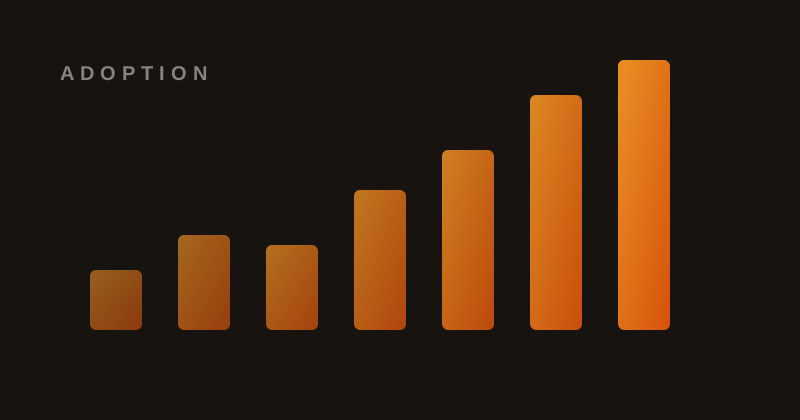
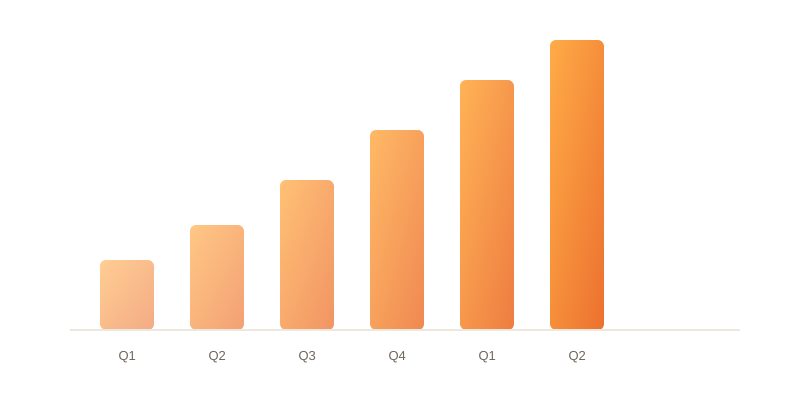
The deployment signals in the Global Labor Graph now show that curve flattening — while a different curve steepens underneath it. Agentic deployments, where AI carries a defined slice of the workflow with human review at the edges, are the fastest-growing category we track.
Why the plateau
Copilots make individuals faster without changing what the organization does. That’s exactly why their measured value is so hard to find: the saved minutes scatter across the week and get reabsorbed. A payments company we studied hit 99% copilot adoption — and Finance couldn’t locate the return.
Agentic deployments force the question copilots let you skip: which part of this work should move, and who reviews what remains? Answering it means redesigning the workflow — and redesigned workflows are where measurable value lives.
What the leaders do differently
The enterprises converting agents into returns share a pattern:
- They start where the work is measurable — claims, contracts, triage, reconciliation
- They put human review at the highest-consequence points, not everywhere
- They score readiness first — an agent dropped into an unready workflow fails louder than a copilot ever could
The takeaway
The shift from copilots to agents isn’t a tooling upgrade. It’s the moment AI adoption stops being a procurement decision and becomes a work-design decision. The enterprises treating it that way are pulling away from the ones that aren’t — and the gap is visible in the data.